
Understanding how tutors identify learning gaps in students is essential for providing effective academic support. In Singapore, where students progress through a structured and academically demanding education system, identifying gaps early can make a significant difference to confidence, subject mastery, and examination performance.
A student may appear to understand a topic because they can complete familiar exercises, yet struggle when questions require them to apply the same concept in different ways. This is why experienced tutors look beyond marks alone. They examine how students think, where mistakes occur, and whether foundational knowledge is strong enough to support more advanced concepts.
For parents and students in Singapore, this approach is particularly valuable because academic progress is cumulative. A weakness in Primary Mathematics, for example, can affect a student’s ability to handle more complex problem-solving later. Similarly, gaps in English comprehension or writing skills may become increasingly apparent as students encounter more demanding texts and examination questions.
What Are Learning Gaps?
A learning gap is a missing piece of knowledge or an underdeveloped skill that prevents a student from progressing confidently to the next stage of learning. It does not necessarily mean that a student has failed a particular topic.
For example, a Primary student may know how to perform basic multiplication but struggle with multi-step word problems. The issue may not be multiplication itself. The underlying gap could involve reading comprehension, identifying relevant information, selecting the correct operation, or organising the steps needed to reach an answer.
We therefore view learning gaps as more than incorrect answers. They represent areas where a student’s understanding, application, or foundational skills are not yet sufficiently developed.

How Do Tutors Identify Learning Gaps in Students?
Effective tutors generally use several methods rather than relying on a single test. The goal is to create a clearer picture of what the student knows, what they can apply independently, and where additional support is needed.
1. Diagnostic Assessments
A diagnostic assessment is one of the most useful starting points. Instead of simply testing the most recently taught chapter, tutors can use questions covering relevant concepts from earlier stages of the curriculum. For a Singapore student, this could involve assessing prerequisite skills before beginning a new topic. A Secondary Mathematics student studying algebraic equations, for instance, may first need to demonstrate competence in arithmetic operations, fractions, negative numbers, and basic algebraic manipulation. The tutor can then distinguish between a student who has difficulty with the new concept and one whose difficulty originates from an earlier foundational gap.
2. Analysing Mistakes, Not Just Marks
Two students can receive the same score while having completely different learning needs. One student may make careless calculation errors despite understanding the concept. Another may consistently choose the wrong method because the underlying concept has not been understood. Treating both students in the same way would not be effective.
Tutors therefore analyse patterns in mistakes. They may look at whether a student repeatedly misreads questions, skips important steps, applies an incorrect formula, struggles with vocabulary, or depends heavily on memorised procedures. This process helps tutors identify the root of the problem rather than repeatedly correcting the same visible mistake.
3. Asking Students to Explain Their Thinking
A student’s written answer does not always reveal how they arrived at it. Asking students to explain their reasoning can uncover misunderstandings that may otherwise remain hidden. For example, a tutor might ask a student to explain why a particular mathematical method works rather than simply asking them to produce the answer. If the student can obtain the correct answer but cannot explain the reasoning, the tutor may recognise that the knowledge is procedural rather than conceptual. This is particularly important when preparing students for questions that require application, reasoning, and problem-solving rather than straightforward recall.
4. Reviewing Schoolwork and Assessment Results
Tutors can gain valuable information from school assignments, examination papers, worksheets, and teacher feedback. Reviewing several pieces of work over time is often more informative than reviewing a single test. For Singapore students, school assessments can provide useful evidence about recurring weaknesses across subjects and topics. A tutor can compare classroom performance with diagnostic assessment results to determine whether a difficulty is isolated or part of a broader pattern. The objective is not simply to identify which questions were wrong, but to understand why the student struggled and whether the same weakness appears repeatedly.
5. Observing Learning Behaviour
Learning gaps can also become visible through behaviour during tuition sessions. A student who frequently avoids certain questions, needs repeated prompts, takes significantly longer than expected, or relies heavily on examples may be signalling a lack of confidence or understanding. We should not automatically interpret these behaviours as a lack of effort. In many cases, avoidance is a response to uncertainty. Once tutors identify the underlying difficulty, they can provide more appropriate scaffolding and gradually develop the student’s independence.
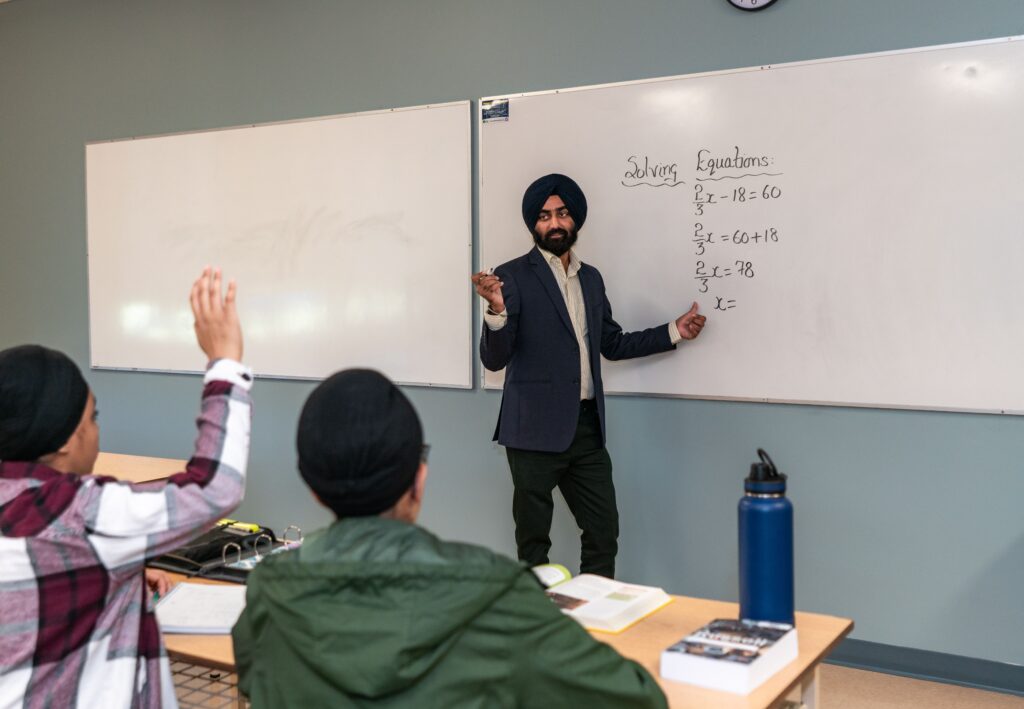
Why Identifying Learning Gaps Matters in Singapore
Singapore’s education system places significant emphasis on building strong foundations before students progress to increasingly complex material. Students may encounter different academic demands as they move through Primary and Secondary education and prepare for national examinations. This makes early intervention particularly important.
A small gap in one academic year can become more difficult to address later if new concepts are continuously built upon incomplete foundations. For example, difficulty with fractions can affect percentages, ratios, algebra, and more advanced mathematical applications.
The same principle applies to languages. A student who has weaknesses in vocabulary and comprehension may find increasingly complex English passages more challenging as academic expectations rise. For tutors, identifying the gap early allows tuition to become more targeted rather than simply adding more practice exercises.
How Tutors Turn Learning Gaps Into a Personalised Learning Plan
Once a gap has been identified, the next step is to determine the most appropriate intervention. Effective tuition should not mean repeatedly teaching an entire syllabus from the beginning. Instead, tutors can prioritise the specific prerequisite skills that are preventing progress.
For example, if a student struggles with algebra because of weak fraction skills, the tutor can temporarily focus on fractions before returning to algebra. Once the foundation improves, the student can revisit algebra with greater confidence. Progress should also be monitored continuously. Short assessments, targeted exercises, verbal questioning, and review activities can help tutors determine whether the intervention is working. This creates a cycle of assessment, targeted teaching, practice, and reassessment rather than a one-size-fits-all approach.

Supporting Singapore Students Beyond Examination Preparation
Exam preparation remains an important part of academic tuition, but identifying learning gaps can yield benefits that extend beyond improved examination scores. When students understand concepts more clearly, they often become more confident in approaching unfamiliar questions. They can also develop better study habits because they understand which areas require attention, rather than spending equal time on every topic.
For parents, this provides a more meaningful way to evaluate tuition. Instead of asking only whether a child’s marks have improved, parents can ask whether the student has overcome specific weaknesses, become more independent, and demonstrated stronger understanding.
The Role of Tutors in Closing Learning Gaps
A skilled tutor acts not only as an instructor but also as a learning diagnostician. By combining assessment results, mistake analysis, questioning, observation, and regular progress monitoring, tutors can develop a clearer understanding of each student’s individual needs.
For Singapore students, this personalised approach is especially valuable in an academically competitive environment where strong foundations can influence performance across multiple years of study. Ultimately, understanding how tutors identify students’ learning gaps helps us see why effective tuition should begin with diagnosis rather than immediately moving into more exercises. When tutors identify the root cause of a student’s difficulty and address it systematically, students have a stronger opportunity to build lasting understanding, confidence, and academic independence.