
Understanding Deep Learning in the Bigger AI Picture
When we talk about deep learning today, we are really talking about the engine driving much of modern artificial intelligence. We see it behind recommendation systems, image recognition, speech recognition, and the large language models that power many AI-powered tools. Deep learning is a form of data-driven learning built on artificial neural networks with many hidden layers, which is why we call these models “deep.” Unlike traditional machine learning, where we often handcraft features, deep learning automatically discovers useful patterns in data using layered transformations. This ability to learn complex representations is what enables it to work so well on images, audio, and natural language.
We still see deep learning as one part of the broader machine learning ecosystem, not a replacement for everything that came before. Classical methods such as Gaussian processes, decision trees, or linear models remain useful, especially when data is limited or interpretability matters. What deep learning adds is the capacity to scale with large datasets and accelerated computing resources in the data centre or cloud. Thanks to GPUs and specialised chips from companies like NVIDIA and cloud platforms such as Vertex AI, Paperspace Gradient, and others, we can train models with billions of parameters on massive datasets. This combination of algorithms, data, and infrastructure is what makes modern AI systems practical in the real world.
How Neural Networks Learn: From Input Layer to Output Layer
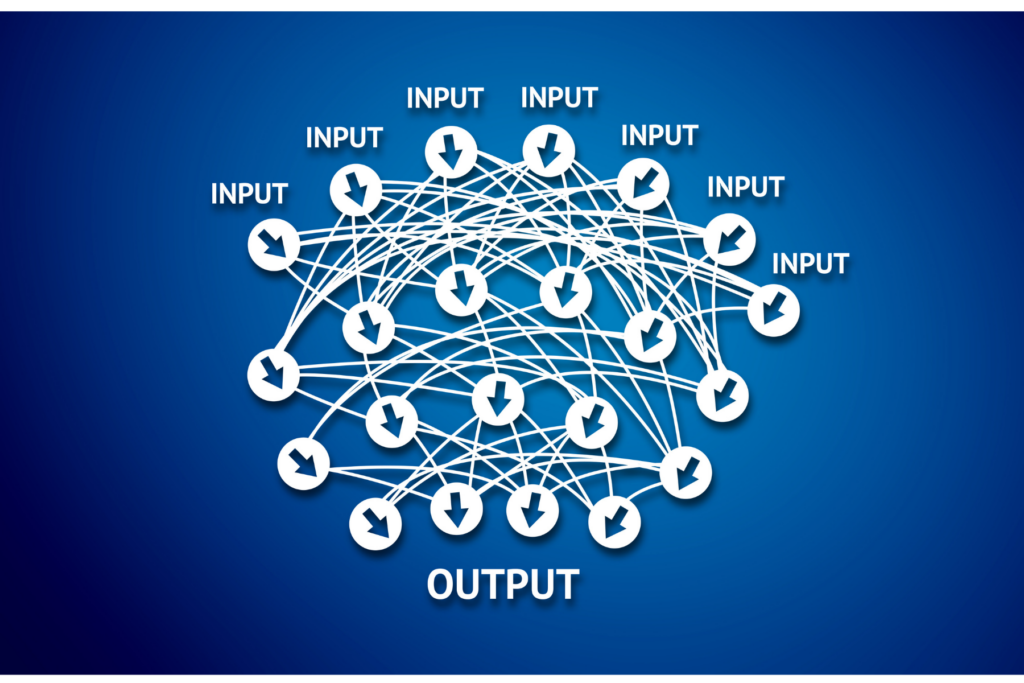
At the core of deep learning are artificial neural networks, which we can picture as layered graphs of simple computational units. The input layer receives raw or preprocessed data: pixel values for image classification, spectrograms for speech recognition, or token embeddings for natural language processing. Between the input and output layer, we have several hidden layers that transform representations step by step, using activation functions such as ReLU, sigmoid, or tanh to introduce non-linearity. Each connection between neurons has an adjustable weight, and learning means finding values of these weights that yield good predictions.
The learning process relies heavily on gradient descent and its variants as optimisation algorithms. We define a loss function that measures how far the model’s output is from the desired target, such as a misclassification in image recognition or an incorrect sentiment in sentiment analysis. By computing gradients of this loss with respect to the network’s weights and updating them in small steps, we move the model through a high-dimensional latent space of parameters toward better solutions. Techniques such as Batch Normalization, advanced optimisers, and careful hyperparameter optimisation make this process more stable and efficient. In some advanced scenarios, we even bring in Gaussian processes or Bayesian methods to guide hyperparameter search.
As models deepen, we face challenges like vanishing or exploding gradients, overfitting, and training instability. Here, architectural innovations and regularisation techniques matter a lot: residual connections, dropout, and normalisation layers help networks train deeper and generalise better. More specialised architectures—convolutional nets, Recurrent Neural Networks, Long Short-Term Memory (LSTM) networks, transformer models, graph neural networks, and Boltzmann machines—each alter this basic template in ways that suit particular data structures. What stays consistent is the idea of layered, differentiable computation optimised by gradient-based methods.
Core Architectures: CNNs, RNNs, Transformers, and Beyond
Different problems call for different network designs, and we typically group deep learning models by the data structures they handle best. For image classification, object detection, and broader computer vision tasks, Convolutional Neural Networks (CNNs) or convolutional nets dominate. They use convolutional filters that slide across images, detecting edges, textures, and shapes in early layers and more abstract concepts like faces or organs in deeper layers. This design is the backbone of applications ranging from radiology images in healthcare to face generation and facial analysis, including specialised tasks such as Facial Dysmorphology detection.
For sequential data such as text, audio, and time series, Recurrent Neural Networks (RNNs) and Long Short-Term Memory networks traditionally played a central role. They process inputs step by step while maintaining a hidden state that captures context over time, which proved effective for speech recognition, machine translation, and sequence-to-sequence learning. However, they struggle with very long sequences and parallelisation challenges. This limitation led to the rise of transformer networks, which rely on Attention Mechanisms to focus on relevant parts of the sequence regardless of distance.
Transformers now power most cutting-edge natural language processing systems, from Google Neural Machine Translation to many large language models hosted on platforms like Hugging Face. The same transformer models are also being adapted for vision, speech, and multimodal tasks that combine text, images, and even sensor data. Beyond these, we see progress with graph neural networks for relational data, deep belief networks and Boltzmann machines in more specialised contexts, and Physics-informed neural networks for solving partial differential equations. Together, these architectures form a flexible toolkit we can tailor to computer vision, language, scientific computing, and more.

Generative AI: GANs, Diffusion Models, and Neural Style Transfer
A particularly exciting branch of deep learning is generative AI, in which models generate new data rather than merely classify existing examples. Early breakthroughs came from Generative Adversarial Networks (GANs), which pair a generator network that produces samples with a discriminator that distinguishes generated samples from real data. Through adversarial training, GANs learn to produce highly realistic images, enabling applications such as face generation, synthetic radiology, and creative artwork. However, GANs can be tricky to train and may suffer from issues like mode collapse.
In recent years, diffusion models have emerged as powerful alternatives for generative AI applications. These models learn to gradually denoise random noise into coherent images or other data, yielding highly detailed, controllable outputs. Many modern text-to-image systems and creative neural style transfer pipelines rely on diffusion-based methods that combine the aesthetics of one image with the content of another. We also see generative models applied to audio, video, and 3D content, expanding creative and industrial use cases.
Generative AI extends far beyond art and entertainment. In science and engineering, generative models support drug discovery, materials design, and even weather prediction by proposing candidate molecules or simulating physical systems. In business, they enhance customer service with realistic conversational agents and assist in content creation for marketing or documentation. With all this power, we must also consider adversarial attack risks, where small perturbations are crafted to fool models, as well as broader ethical concerns around deepfakes, misinformation, and misuse. Responsible deployment, transparency, and regulation become essential as generative AI tools spread.
From Vision to Language: Key Application Domains
Deep learning now touches almost every major AI use case that operates at scale. In computer vision, CNNs and their descendants power image classification, Object Detection, and instance segmentation for autonomous driving, medical imaging, agriculture, and manufacturing quality control. Systems such as Google Maps and other navigation tools rely on deep models to interpret satellite imagery, street-level images, and traffic patterns. In healthcare, analysing radiology images with deep learning helps flag abnormalities, supports diagnostics, and augments expert judgment.
In natural language processing, transformer-based models drive machine translation, summarisation, question answering, and sentiment analysis across hundreds of languages. Platforms like Hugging Face make it easy to access pre-trained transformer networks and large language models that we can adapt to domain-specific tasks. These models enable highly capable customer service bots, smarter search systems, and AI assistants that can read, write, and reason over complex documents. Companies ranging from Google Brain to DeepLearning.AI, as well as many AI leaders, have contributed foundational research, popular books such as Machine Learning Yearning, and courses that have shaped best practices.
Beyond perception and language, Reinforcement Learning and deep reinforcement learning apply deep networks to decision-making in environments that respond over time. We see this in robotics, game-playing agents, industrial control, and the emerging field of Digital Twins, where simulated environments help optimise real systems. Frameworks built on the Robot Operating System integrate perception, planning, and control for autonomous robots. In data-driven operations, deep learning models support recommendation systems, anomaly detection, and demand forecasting, helping organisations act faster and more accurately.
Learning Deep Learning: Ecosystem, Education, and Tools
Becoming effective with deep learning today is less about inventing new algorithms and more about mastering the ecosystem of tools, workflows, and learning resources. Students and professionals can start with high-quality introductions from sources such as MIT Press, DeepLearning.AI, and other reputable publishers and online academies. Programs like the NVIDIA Deep Learning Institute, specialised schools such as Heicoders Academy, and hands-on platforms like Paperspace Gradient offer structured paths from fundamentals to advanced projects. Reading practice-oriented material, such as Machine Learning Yearning, helps us reason about problems and design data-centric solutions.
On the tooling side, we typically rely on high-level libraries built on top of frameworks such as TensorFlow and PyTorch to implement convolutional nets, transformer models, and sequence-to-sequence learning systems. Cloud services such as Vertex AI allow us to manage data pipelines, training jobs, and model deployment without handling every infrastructure detail. Hyperparameter optimisation platforms automate the search over learning rates, batch sizes, and architectural choices, sometimes combining gradient-based methods with Bayesian or evolutionary strategies. For organisations running at scale, accelerated computing in the data centre—GPUs, TPUs, and other specialised hardware—becomes a strategic asset.
We should also be aware of good engineering practices that turn models into reliable AI-powered tools. Monitoring model performance over time, handling data drift, and defending against adversarial attacks are as important as achieving high benchmark scores. In safety-critical domains such as radiology, facial analytics, or weather prediction, we often combine deep learning with domain-specific models and expert oversight. The goal is not just to build accurate systems, but to integrate them into real workflows in a way that is robust, fair, and accountable.

Responsible and Future-Ready Deep Learning
As deep learning capabilities expand, questions of responsibility and long-term impact grow more important. Data privacy, especially in applications such as Facial Dysmorphology screening or customer service logs, must be carefully protected through anonymisation, access controls, and regulatory compliance. Bias and fairness need explicit attention in data collection, labelling, and evaluation, because models simply mirror patterns in data, including harmful ones. Techniques for interpretability, calibration, and robust optimisation help us understand when models are likely to fail and how to respond.
Looking ahead, we can expect tight integration between physics-based models and Physics-informed neural networks for tasks involving partial differential equations in engineering, climate science, and materials. We will likely see more efficient architectures that do more with less data and compute, improvements in transfer learning that make adaptation to new tasks cheaper, and broader use of Digital Twins for complex systems. Combined with advances from organisations such as Google Brain, these directions point toward AI systems that are both more capable and more aligned with human goals.
In practice, deep learning is no longer an isolated research field but a central pillar of modern computing and data science. From recommendation systems and Google Neural Machine Translation to industrial Digital Twins and real-time customer service, we see neural networks and generative AI applications woven into the infrastructure of everyday life. By combining solid theoretical foundations with careful engineering and ethical consideration, we can continue to expand what AI can do while maintaining trust and safety for the people it serves.